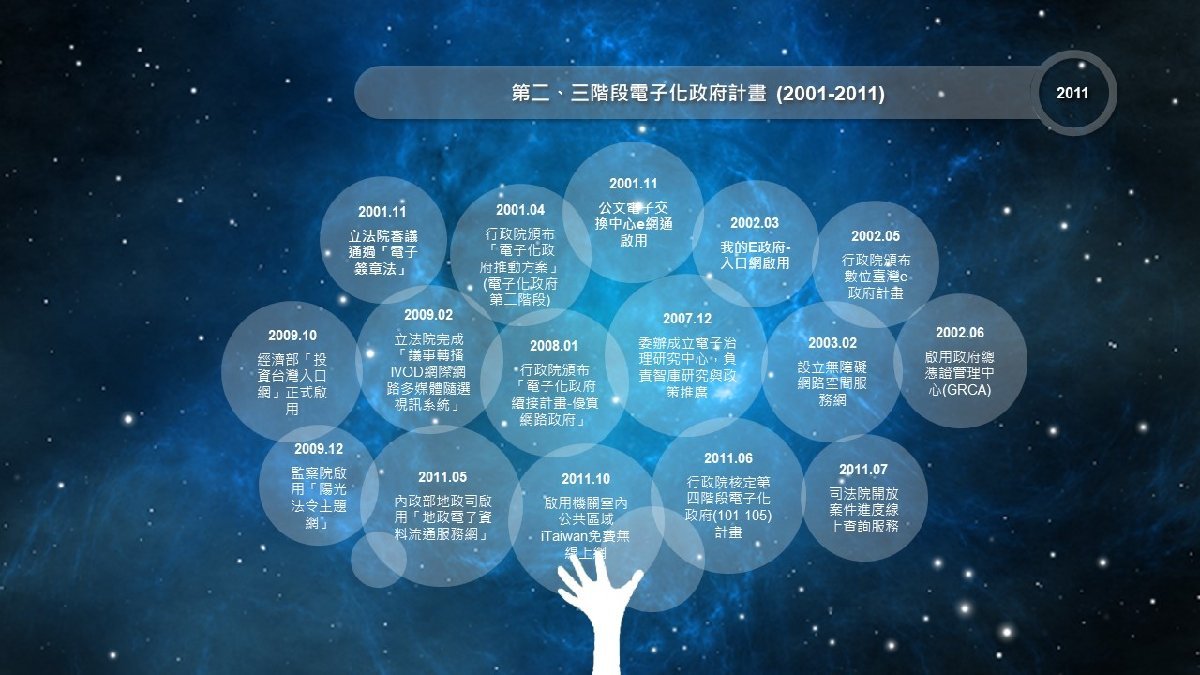
Stages of e-Government Development
Since 1998, Taiwan has launched four stages of the e-Government initiative. Building upon the achievements of these programs, the government is now advancing toward a digital and smart government.
First Phase: Foundational Infrastructure
The first stage of e-Government focused on establishing government network infrastructure, developing online public services, and promoting administrative applications.
Second Phase: Service Expansion and Efficiency
The second stage aimed to promote and popularize online government services. By leveraging information and communication technologies (ICT), it sought to implement government data exchange and reduce the need for official transcripts, thereby enhancing administrative efficiency and fostering innovative public services.
Third Phase: Integrated and Streamlined Services
The third stage emphasized simplifying service processes. Under an integrated and interoperable ICT architecture, government agencies were connected nationwide to provide proactive and easily accessible information services.
Fourth Phase: Innovative Web 2.0 Services
The fourth stage made use of Web 2.0 and social networking technologies to deliver innovative services that better meet user needs—focusing on proactive, targeted, and end-to-end public services.
Fifth Phase: Service-Oriented Smart Government
The fifth phase primarily aims to achieve three major goals: "Provide people-centric and convenient services", "Promote open, transparent, and intelligent governance", and "Enhance data-driven decision-making efficiency".
Sixth Phase: Service-Oriented Smart Government 2.0
The sixth phase, in response to Taiwan's current socio-economic background and international development trends, deepens the goals of "accelerating data release and promoting data reuse," "leveraging public data to open new perspectives in policy-making," and "integrating emerging technologies to create a new era of innovative service."